

Searching for smoother roads


SOUTH Australians are turning to Google for information about potholes, road conditions and road closures as regional councils grapple with maintaining thousands of kilometres of roads and a longstanding funding shortfall.
Yorke Peninsula Country Times analysed Google Trends data for the search terms “potholes”, “road conditions” and “road closures” across South Australia over the 12 months from September 2025 to September 2026.
The data tracks how interest in those searches changed throughout the year, providing a snapshot of what South Australians were looking for when road conditions became a concern.
Google Trends does not measure the total number of searches.
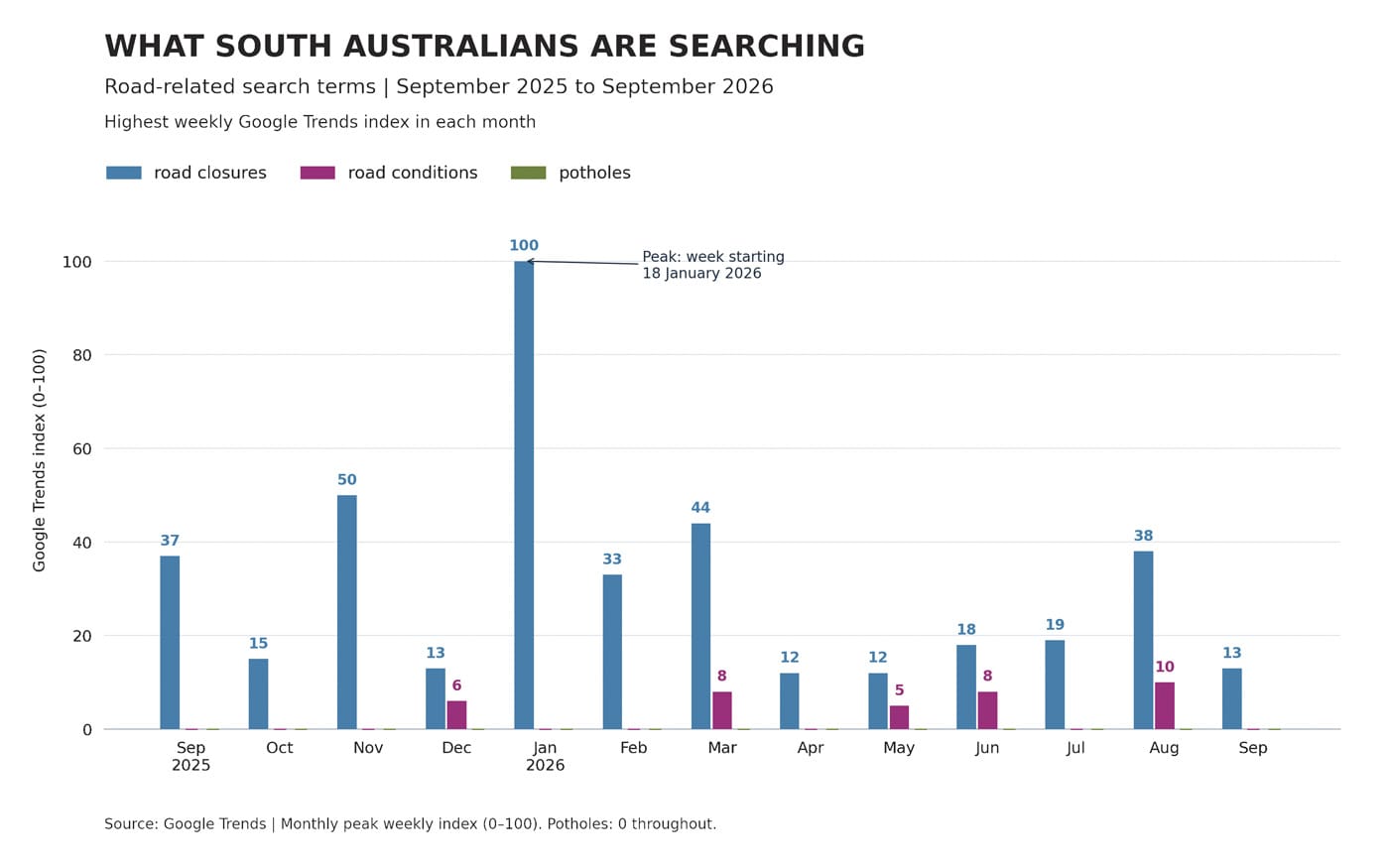
Instead, search interest is measured on a relative scale from zero to 100, with 100 representing the highest level of interest for a term during the selected period.
For Yorke Peninsula motorists, the scale of the road network behind those searches is enormous.
Yorke Peninsula Council manages about 3890 kilometres of roads.
Just 529km are sealed.
Of the remaining 3361km, about 86 per cent of council’s entire road network consists of gravel-sheeted roads, formed and graded roads, and unformed roads and tracks.
It is the largest unsealed council road network in South Australia.
Those roads are particularly important to the region’s agricultural industry, carrying grain, livestock, farm machinery and heavy vehicles across the peninsula.
Road maintenance and improvements remain council’s single largest area of expenditure in its adopted 2026-27 budget.
Copper Coast Council maintains approximately 300km of sealed roads and 630km of unsealed roads, while Barunga West Council is responsible for 930km of roads, of which about 850km are unsealed roads or tracks.
But the challenge facing regional councils is not simply the number of kilometres they maintain.
South Australian local councils are responsible for about 11.8 per cent of Australia’s local road network, yet the state receives just 5.5 per cent of the national Identified Local Road Grants allocation.
In simple terms, SA’s share of that funding is less than half its share of the national local road network.
The gap is significant enough that the Federal Government provides South Australia with separate Supplementary Local Road Funding specifically to address what the state government describes as an inequity in the national allocation.
Weather can make the maintenance task even harder.
Yorketown recorded 58.8 millimetres of rain in the 24 hours to August 25, smashing its previous August daily rainfall record of 45.5mm set in 1941.
It was the highest August daily total recorded at Yorketown in 147 years of observations.
Heavy rain caused flooding across parts of Yorke Peninsula and placed further pressure on roads and drainage infrastructure.
Road surfaces are already the biggest infrastructure complaint among regional South Australian motorists.
Data from RAA’s Report a Road platform found 51 per cent of regional submissions concerned road surfaces such as potholes, cracks and sunken pit covers, compared with 37 per cent of metropolitan submissions.
For Yorke Peninsula Council, maintaining the network is a continual contest between distance, weather, heavy vehicles and available money.
For motorists, the signs of that pressure can be considerably simpler.
A rough road, a pothole, a closure and, increasingly, a Google search looking for answers.
Source: Google Trends
This content is part of a paid partnership with Google to promote Google Trends.


